
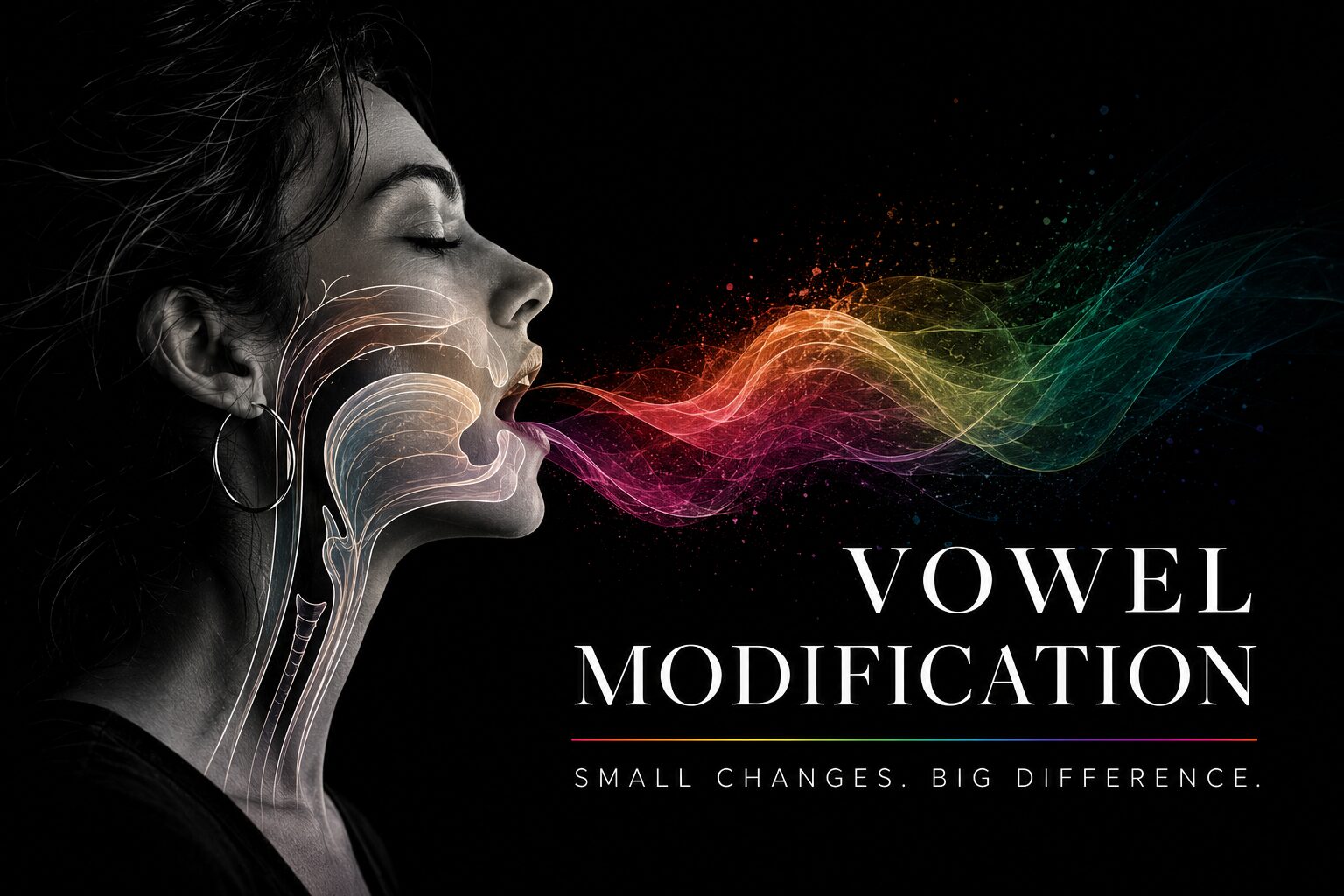
Vowel modification means making a small adjustment to the shape of a vowel as you sing.
Usually, this means making the vowel slightly more open, more closed, more spread or more rounded as the pitch changes.
This changes the shape of your vocal tract (your tongue, jaw, lips and mouth), which can affect both the sound of your voice and how easily a note is produced.
Why modify vowels?
We generally modify vowels for two reasons:
- To change the tone or colour of the voice.
- To make high notes easier and reduce unnecessary effort.
Changing the Tone
Different vowel shapes naturally produce different vocal colours.
As a rough guide:
- Adding a little A, EE, IH, EH often creates a brighter, more speech-like sound.
- Adding a little UH, OH, OO often creates a warmer, rounder sound.
Experiment with different vowels and notice how the colour of your voice changes, even when the note stays the same.
Singing Higher
As pitch rises, some vowel shapes become harder to maintain.
Rather than forcing the original vowel, many singers allow it to change slightly.
For example:
- EE may drift slightly towards IH.
- IH may drift slightly towards EH.
- EH may drift slightly towards AH.
- AH may become slightly rounder.
Some teachers prefer a simpler approach, encouraging singers to gradually modify towards A (æ) or UH depending on the sound they’re trying to achieve and what the voice needs.
Does vowel modification change the vocal folds?
Not directly.
Vowel modification changes the vocal tract, not the vocal folds.
However, changing the acoustics of the vocal tract can make singing easier and may encourage the voice to find a more efficient coordination.
Final Thoughts
Think of vowel modification as gently reshaping the vowel rather than replacing it. The listener should still hear the original word.
There isn’t one correct way to modify vowels.
Different teachers explain it differently, but they’re all trying to help you find the vowel shape that gives you the sound you want with the least amount of unnecessary effort.


