C.V.T
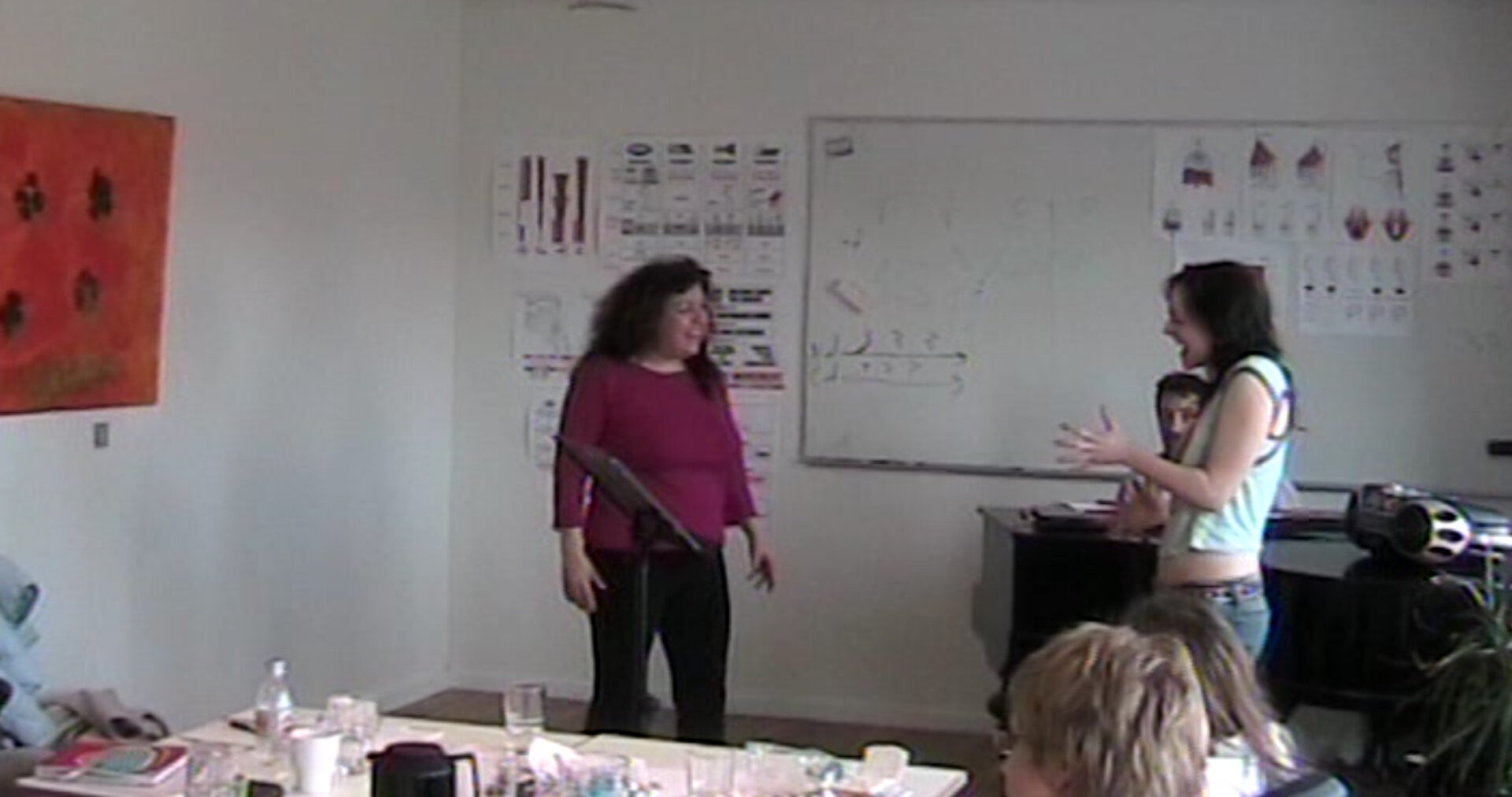
Around twenty years ago, I trained for a diploma in Complete Vocal Technique at the Complete Vocal Institute in Copenhagen. I was fortunate enough to be taught directly by Cathrine Sadolin.
One of the most exciting areas of CVT at that time was their comfort with teaching vocal effects; textures/sounds that come from different parts of the vocal tract added onto tone to create emotion. Whilst there is no agreed terminology, Titze uses the definition:
‘Irregular and/or multi-source vibration with non linear dynamics, producing rough or distorted voice quality’
A neural network model of vocal fold oscillation with subharmonics and bifurcations.
Common Vocal Effects Include:
While there are many effects, the ones my clients tend to use most are:
- Distortion – A gritty, raspy sound caused by false vocal fold vibration
- Creak – A creaky sound created at the level of the true vocal folds
- Rattle – A chaotic, growly texture involving the arytenoids and cartilage structures
- Growl – A deep, dark version of rattle created by the arytenoids drumming on the epiglottis
Please note the names aren’t really important as everyone names these things differently.
Important notes:
Before we play with some sounds, there are some important things to know!
*Most effects (with the exception of creak) happen above the true vocal folds, meaning they are layered on top of a clean, supported vocal sound. So before adding any effect, it’s essential you can sing the phrase cleanly without the effect. Ensuring that your vocal fundamentals are in place (particularly breath support). You should be able to move from clean to effected and back to clean again with no issues.
*Effects require a lot of energy. They are primal types of sounds. They must be connected with artistic intention to express emotions to sound authentic and good. For many, vocal effects are the hardest things to achieve, so if you’re struggling I definitely suggest you work with a coach!
*Vocal effects often give the effect of being louder than they actually are. Take care with volume when playing with effects. They do not have to be loud! It’s important you are aware of volume and effort levels when making these sounds. And if required make use of tools which can help you hear yourself well.
*The usual advice regarding vocal health should of course be followed such as ensuring your voice is well hydrated and you’re getting enough vocal rest. Possibly steaming your voice (min 30mins before singing).
*Effects should never feel uncomfortable. It’s fine to do something slightly wrong once or twice while learning — that’s part of the process — but you must always trust your body’s feedback. If something feels wrong, stop. (You can help your voice recover by yawning and stretching the back of the tongue. These stretches can release tension in the constrictor muscles of the throat – but don’t keep repeating incorrectly).
*If your voice is tired, hoarse, or recovering — avoid effects entirely until you’re fully rested.
*If you’ve never worked on vocal effects before reach out to an experienced vocal coach.
Now, let’s take a look at a few of the most common vocal effects.
Distortion
What it is: Vibration of the false vocal folds, layered over a pitched tone or used on its own (full distortion).
Examples:
- Janis Joplin – Ball and Chain
- Metallica – Enter Sandman
Find distortion:
- Imitate the sound of annoyance ‘aaaaaaa’
- Smile to lift the tone
- Add twang
- Animate the body
- Start with short, energetic bursts not sustained phrases
- Raise the larynx and keep the tongue high
- The lower belly should be drawing in with resistance
Once you’ve found the sound you can see if you can add it to your phrase.
Tips if it’s not working;
Some effects can make the voice sound louder, but the actual volume underneath is often lower. So try reducing the volume.
Ensure your breath support is right
Another great exercise is the twangy duck quack plus the rasp with the tongue out!
Some singers find it helpful to imagine the distortion as a subharmonic tone of the pitch they’re singing.
Creak
What it is: creak is a kind of lighter version of distortion. It stays quiet/medium volume
Examples:
- PJ Harvey – Send His Love to Me
- Björk – 5 Years
- Sam Brown – Stop
Find Creak:
- Start with a clear note and gently allow it to fall into a creaky, fry-like sound
- Use overdrive settings e.g. ‘EH’, OH’ with a bite mouth but turn down the volume (My favourite!)
- Sing like a creaky door being opened!
This can be a nice way to find distortion: make vocal fry in the inhale, low to high (which is easy), then impersonate the same sound on exhale.
Rattle
What it is: Rattles can happen at the arytenoids, uvula the cartilaginous structures above the folds. This can sound like a lazy distortion, particularly when breath support is more relaxed.
Examples:
- Jeff Buckley – Grace
- Björk – Immature (listen for the uvula rattle)
Find rattle:
- Stick your tongue out and say “arrrgh”
- Try to make a rolling ‘rrr’ at the uvula
- Keep the sound light
- Stay light with airflow — don’t push too hard
Growl
What it is: A darker version of rattle, where the arytenoids and sometimes the epiglottis interact
Examples:
- Christina Aguilera – Fighter
- Louis Armstrong – his classic vocal tone
How to explore growl:
- Try gently clearing your throat (without excessive force or airflow)
- Imitate a roaring lion, at easy pitch then play around with it; ‘raaaarrrrr’
Final Thoughts
Exploring vocal effects is a bit like stepping into a giant playground. There’s room for energy, chaos, beauty, and truth — but it all needs to be supported by solid technique, emotional honesty, and clear intention. This work is advisable to do with a vocal coach.
If you’re willing to experiment, stay grounded in your technique, and trust your body’s feedback, you’ll discover just how expressive and powerful your voice can become.
If you’d like support exploring vocal effects with clarity, safety and expressive depth, I offer expressive voicework, vocal coaching and artist development in London and online worldwide. When you’re ready to discover new colours and textures in your voice, you’re welcome to reach out.